A 1600 is not one test, it is two stages. Before a perfect score is even available to you, Module 1 has to route you into the harder Module 2 in both sections, roughly 18 of 27 correct in Reading & Writing and 15 of 22 in Math. Only the harder path reaches 800. Clear that bar and the second stage begins, and the second stage has almost no margin: on our model of the curve, 1600 means missing essentially nothing.
Most advice about perfect scores is about studying harder. The mechanically interesting part is the routing, because it means the questions that decide whether 1600 is possible are among the easiest on the test.
Stage one: qualifying
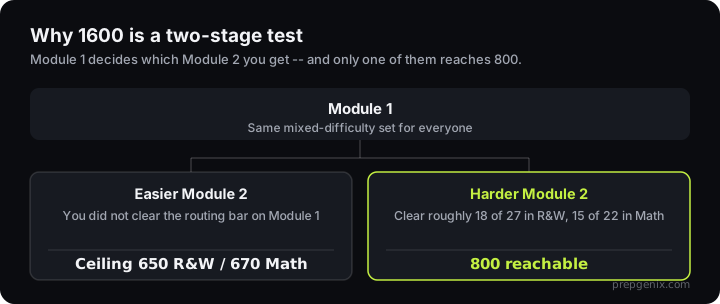
Each section is two modules. Module 1 is the same mixed-difficulty set for everyone. Your performance on it decides which Module 2 you get, and the easier one carries a hard scaled ceiling, around 650 in Reading & Writing and 670 in Math. Route easy in both and the highest total available to you is about 1320, however flawless the second module is. The two-module design is documented in College Board's test structure.
Which produces a counterintuitive consequence. A careless error on an easy Module 1 question is more expensive than getting a hard Module 2 question wrong. The first can cost you access to an entire scoring range; the second costs you one question. Students chasing 1600 who drill only hard material have the priority backwards. The score calculator shows exactly what each module path allows.
College Board publishes no canonical raw-to-scaled table, and none comes with a real score report. The ceilings and thresholds here come from our own model of the curve, built on the published Bluebook practice-test conversions. The structure is solid; the exact points are an approximation, and we would rather say so than quote a false precision.
The routing bar, in numbers
| Section | Module 1 correct to route hard | Easier-path ceiling | Harder path |
|---|---|---|---|
| Reading & Writing | about 18 of 27 | ~650 | 800 reachable |
| Math | about 15 of 22 | ~670 | 800 reachable |
| Total | ~1320 | 1600 |
Stage two: the margin
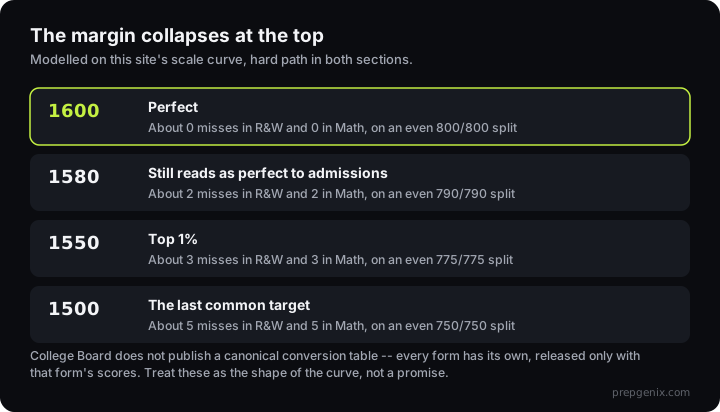
Read that ladder carefully, because the shape is the point. Going from 1500 to 1550 costs you roughly two questions of margin per section. Going from 1550 to 1600 costs you the remaining three. At the top the curve is nearly vertical: one careless arithmetic slip is 10 to 15 scaled points, and there is nothing left to absorb it.
This is why students who reliably score 1520 often stall. The problem is almost never a content gap at that stage. It is that a 1520 performance contains three or four unforced errors, and unforced errors are a harder thing to eliminate than a missing topic.
What separates 1500 from 1600
Three things, in this order:
1. Unforced errors, which are not a knowledge problem
Misread the question, solved for x when it asked for 2x, dropped a negative, picked the trap answer that matches an intermediate step. At 1500 these are typically the largest single category of loss and they respond to process, not study: note what the question is asking before you start, and re-read that note before you select.
2. Advanced Math and Craft and Structure
The last hundred points concentrate almost entirely in two domains. Advanced Math is about 35% of the Math section and it is where high scorers lose points: nonlinear systems, function transformations, exponential models. Craft and Structure is the largest Reading & Writing domain at roughly 28%, and at the top end it is words-in-context items where two choices are both defensible and only one fits the register.
3. Pacing that survives a hard Module 2
The harder Module 2 is hard, and the students who lose points there usually lose them at the end, having spent four minutes on one item. Every question is worth the same. Protecting your ability to reach all 22 is worth more than perfecting any single one.
Is 1600 worth chasing?
Usually not, and this is worth being direct about.
Admissions officers do not read 1600 and 1570 differently. Both are comfortably inside the top 1% and both clear every score-gated scholarship threshold in existence. The marginal admissions value of the last 30 points is close to zero, while the marginal effort is enormous. Those points sit at the steepest part of the curve, and the hours they take could go into an essay, a portfolio or a recommendation relationship that does move a decision.
Two exceptions. If you enjoy it: some students do, and that is a fine reason. And if you are already at 1580 with a test date booked, the remaining gap is small enough that it costs little to try.
Otherwise the honest recommendation is to bank 1550 and spend the remaining time elsewhere. It is the same advice we give at every band: work out what the next 50 points cost, and compare it against what the same hours buy somewhere else in the application.
How rare is a 1600?
Rare enough that percentile tables round it to the 99th and stop being useful. A perfect score is achieved by a few hundred students out of roughly two million annual testers, a fraction of one percent of one percent.
The more useful frame is that 1550 is already the 99th percentile. Everything above it is competing for a distinction that no admissions process draws.
Frequently asked questions
Can you get a 1600 with an easy Module 2?
No. The easier Module 2 carries a scaled ceiling of roughly 650 in Reading and Writing and 670 in Math, so the highest total available on that path is about 1320. Full answer
How many questions can you miss and still get a 1600?
Essentially none. On our model of the curve a 1600 requires a perfect or near-perfect raw score in both sections. A 1580 allows roughly one to two misses in Reading and Writing and two in Math, and a 1550 allows about three per section.
Is 1600 much better than 1550 for college admissions?
Not meaningfully. Both sit comfortably inside the top 1% and both clear every score-gated scholarship threshold. The marginal admissions value of the last 30 to 50 points is close to zero while the effort is at the steepest part of the curve, so those hours usually buy more elsewhere in the application.
What percentile is a 1600 SAT score?
The 99th, which is also where 1550 sits. Percentile tables stop discriminating above that point. A perfect score is achieved by a few hundred students out of roughly two million annual testers.
Why am I stuck at 1500 on the SAT?
At that band the losses are usually unforced errors rather than content gaps: misreading the question, solving for the wrong variable, dropping a negative, or picking a trap answer that matches an intermediate step. Those respond to process changes, not more studying.
Which topics matter most for a perfect SAT score?
Advanced Math, at roughly 35% of the Math section, and Craft and Structure, the largest Reading and Writing domain at roughly 28%. The last hundred points concentrate almost entirely in those two.
Are Module 1 questions more important than Module 2 questions?
In one specific sense, yes. Module 1 decides your routing, and routing decides your ceiling. Full answer
How long does it take to go from 1500 to 1600?
Longer than going from 1300 to 1500, which surprises most people. The curve is nearly vertical at the top, so each remaining point costs disproportionately more work, and the remaining errors are process errors rather than knowledge gaps, which are slower to eliminate.