Two or three times. There is no official limit. College Board caps nothing, and you could sit all eight administrations in a year if you wanted to. But the published research is unusually blunt about diminishing returns: the first retake raises a superscore roughly twice as much as any retake after it. The question worth asking is never "how many am I allowed", it is "does the next sitting have anything new to convert".
What the data says
Two sources are usually cited and they do not say the same thing, which is worth sitting with rather than smoothing over.
College Board reports that around 55% of juniors improved when they retook as seniors, with an average gain of about 40 points. The NBER working paper 24945, "Take Two! SAT Retaking and College Enrollment Gaps", breaks the same behavior down by starting score and finds something more useful:
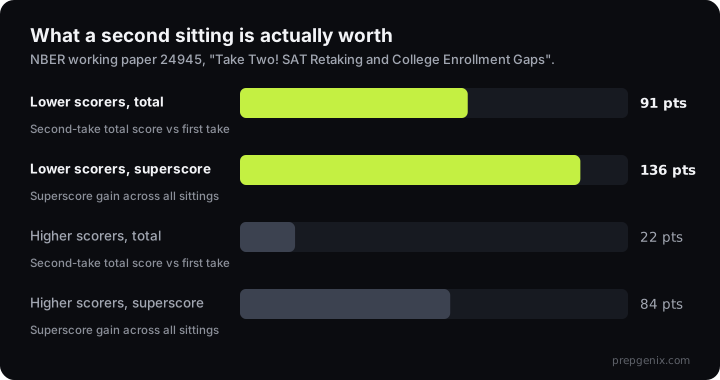
Lower-scoring students gained 91 points on their second total, against 22 points for higher scorers. Measured on superscore across all sittings, the gap is 136 against 84.
So the "average gain of 40 points" number is real and also close to meaningless for any individual, because it is the midpoint of two very different populations. If you are at 1150, the honest expectation is far above 40. If you are at 1480, it is well below. Advice built on the single average will overpromise to one group and discourage the other.
These are observational figures, not the result of a controlled trial. Students who choose to retake are not a random sample. They are disproportionately students who prepared in between. Part of the measured gain is the preparation, not the retake. Which is precisely the point: the sitting does not raise the score, the work between sittings does. Before booking one, convert your practice result with the score calculator to see what a retake is worth.
Retaking with no preparation
Some improvement comes free. You know the interface, the pacing does not surprise you, and test-day nerves are lower the second time. That is real and it is small, commonly cited at 10 to 20 points, which is inside the standard error of measurement. In other words, it is close to no change at all.
Booking a retake and changing nothing is therefore an expensive way to roll the dice. The sitting costs $68 and a Saturday; the score is unlikely to move enough to matter.
The decision rule
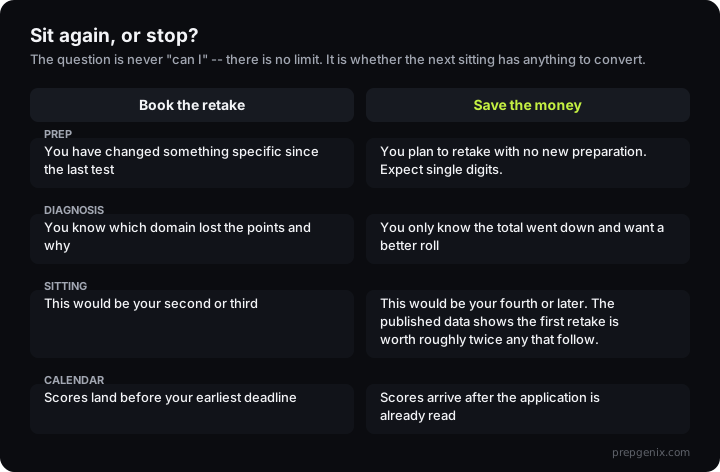
Four questions. If the left column is true for most of them, book it.
Superscoring changes the arithmetic
This is the part that makes an extra sitting cheaper than it looks. Most colleges superscore, taking your best Reading & Writing from any date and your best Math from any other, then adding them. Under superscoring a bad section costs you nothing. It is simply not counted once a better one exists. The full calendar is on College Board's dates and deadlines page.
Which produces a different strategy: on a retake you can afford to attack the weaker section hard, even at some risk to the stronger one, because the stronger one is already banked. Students who do not know this play both sections safe and gain less than they could have.
The exception is the small number of institutions that ask for all scores or consider only your highest single sitting. Check the policy of your actual list before planning around it. Our guide to superscoring covers who does what.
A sitting plan that works for most students
| When | Which sitting | Purpose |
|---|---|---|
| Spring of grade 11 | First | All the content has finally been taught. This is your real baseline, taken with enough runway to act on it. |
| Late summer or early fall of grade 12 | Second | The one the data says matters most. Aug, Sep and Oct all return scores before a 1 November early deadline. |
| October or November of grade 12 | Third, if justified | Only if the second sitting had an identifiable, fixable failure. Otherwise stop. |
| December of grade 12 | Last useful date | Clears most regular-decision deadlines. Past this the calendar closes. |
When a fourth sitting is defensible
The general advice to stop at three is sound, and there are three real exceptions to it:
- Something went wrong in the room. Illness, a device failure, a disruption. That sitting measured circumstances, not you.
- You are chasing a specific threshold with money attached. Some public universities run automatic merit grids where a single 20-point step changes the award. If the next band is worth thousands of dollars, the arithmetic on a $68 sitting is not close.
- Only one section is short and you are superscoring. A fourth sitting aimed at one section, with genuine preparation behind it, is a much smaller ask than a fourth attempt at the whole test.
What is not a reason: hoping for an easier form. Equating exists specifically to remove that variable, and the search for a soft administration is the most reliably wasted effort in SAT preparation.
Does taking it four times look bad?
Effectively no. Admissions officers see scores, not a count of attempts, at the many institutions that superscore or accept Score Choice. Even where all scores are reported, an upward trajectory across sittings reads as persistence rather than as a problem. The real cost of a fourth sitting is not reputational. It is the Saturday, the fee, and the weeks of preparation that could have gone into an essay instead.
Fitting those sittings around coursework is its own problem: SAT prep when everything else is due.
Frequently asked questions
How many times can you take the SAT?
There is no limit. College Board caps nothing, and you could register for all eight annual administrations if you wanted to. The practical limit is that the published research shows the first retake is worth roughly twice as much as any that follow.
How many times should you take the SAT?
Two or three for most students. A first sitting in spring of grade 11 and a second in late summer or early fall of grade 12 covers the majority of cases. A third is worth booking only if the second had an identifiable, fixable failure.
How much does the average student improve on a second SAT?
College Board reports about 40 points on average, with roughly 55% of juniors improving as seniors. That single figure hides a wide split: NBER working paper 24945 found lower scorers gained 91 points on their second total against 22 for higher scorers.
Will my score go up if I retake the SAT without studying?
Barely. Familiarity with the interface and lower nerves are commonly worth 10 to 20 points, which is inside the standard error of measurement and close to no change at all. The measured gains in retake studies mostly reflect the preparation done between sittings.
Does taking the SAT multiple times look bad to colleges?
No. Most colleges superscore or accept Score Choice, so they see scores rather than a count of attempts, and an upward trajectory reads as persistence. The real cost of an extra sitting is the time and the fee, not how it appears.
Do colleges see all my SAT scores?
It depends on the college. Score Choice lets you decide which sittings to send, and most institutions superscore across the ones they receive. A small number ask for all scores. Check the policy of the specific colleges on your list rather than assuming.
Is it worth taking the SAT a fourth time?
Sometimes. It is defensible if something went wrong in the room, if you are chasing a specific scholarship threshold where the next band is worth real money, or if you are superscoring and only one section is short. It is not defensible as a hope for an easier form. Equating exists to remove that variable.
When is the last SAT date that still counts for applications?
December for most regular-decision deadlines, and October for a 1 November early deadline. Working backwards from the 13-day score release, the 3 October 2026 administration returns scores on 16 October, which clears an early deadline comfortably.