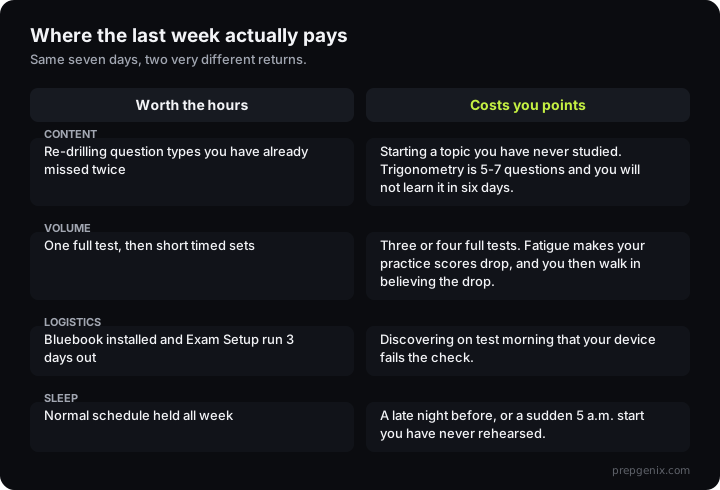
In the last seven days you can still gain points, but only from three things: fixing errors you already know you make, rehearsing pacing, and not sabotaging test day with logistics. New content is not on that list. If you have never studied trigonometry, you will not learn it in six days, and the hours you spend trying are taken from the two things that would have paid.
This is the plan, working backwards from the test. The next weekend administration is Saturday 12 September 2026, with 3 October and 7 November behind it. Confirm your own date against College Board's dates and deadlines page.
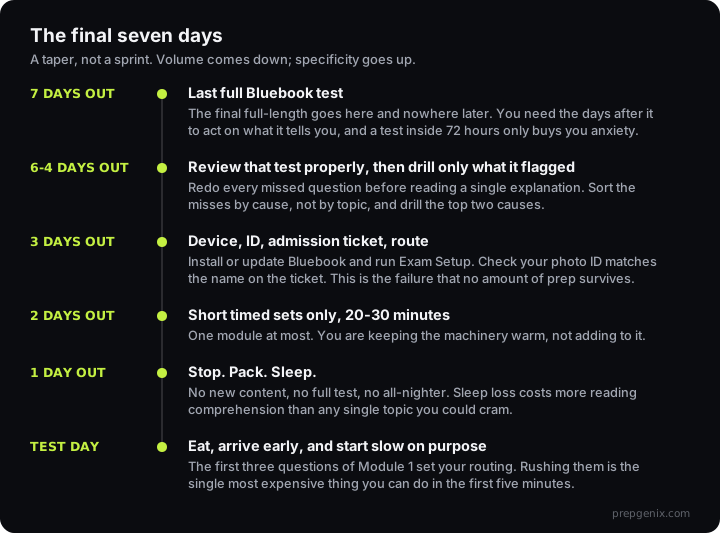
Seven days out: the last full test
Take one full-length Bluebook test, timed, in one sitting. Then stop taking full tests.
That is not superstition about burnout. A full test costs about two and a quarter hours to sit and roughly the same again to review properly. Take one on Wednesday and one on Friday and you have spent the week generating data you never had time to act on. The test is only worth what you extract from it, and extraction is the slow part.
Which form? If you have followed the usual sequence, this is Test 7. Test 11, the prediction test, went two to three weeks out so there was time to act on it. If Test 11 is still unused, take it here instead. Otherwise take the highest-numbered one left that you have not seen. Avoid 8, 9 and 10 if you ever drilled the retired Tests 1–3 as PDFs; those three recycle items from them, and a score inflated by recognition is worse than no score at all.
Six to four days out: review, and only review
Redo every missed question before you read a single explanation. This is the whole method. A question you can solve on the second attempt without help was a process failure; one you still cannot solve is a content gap. Those need completely different responses, and the explanation destroys your ability to tell them apart.
Then sort your misses by cause rather than by topic, count them, and drill the top two causes. Most students discover the count is lopsided, six careless arithmetic slips and two genuine content gaps, and that the thing they were about to spend the week on was the smaller pile.
Three days out: the failures that prep cannot survive
Do this on a weekday evening, not on test morning.
- Install or update Bluebook and run Exam Setup. It is a separate step from installing, and it is the one that surfaces problems while you can still solve them.
- Check your device against the current rules. As of the Fall 2026 administrations, personal Chromebooks are prohibited, only school-managed devices with Verified Mode enabled. Smart glasses are prohibited outright. If your only machine is a personal Chromebook, three days is barely enough to request a loaner.
- Print or save the admission ticket and check the name against your photo ID. They have to match.
- Charge everything, and bring the charger anyway. Battery is your responsibility; outlets are not guaranteed.
- Look up the route and the actual door. Large campuses have more than one entrance and only one of them is open at 7:45 a.m.
The most common test-day failure is not a hard question. It is a device that will not pass the check, an ID that does not match, or an arrival time that turns into a refusal at the door. None of those are prep problems, and all of them cost the entire score.
Two days out: short sets, and nothing more
Twenty to thirty minutes of timed work. One module at most, and preferably half of one. You are keeping the machinery warm, not adding to it.
This is also the last useful day for pacing rehearsal. Pacing is a separate skill from content and it decays faster, which is why a student who has not run a timer in ten days often finishes their first real module three questions short. If you are sitting on 12 September, the domain counts published for that administration tell you where to aim the last rehearsal.
The night before, and the morning
No new content. No full test. No all-nighter. Sleep loss costs more reading comprehension and working memory than any single topic you could cram, and Reading & Writing is 54 of the 98 questions.
Pack the night before: admission ticket, photo ID, charged device, charger, an approved calculator if you want a physical backup, pencils for scratch work, water and something to eat in the break.
On test morning, eat something, arrive early, and then do the one thing almost nobody does deliberately: start slowly.
Why the first five minutes are worth more than the last hour
Each section of the digital SAT is two modules. Module 1 is the same mixed-difficulty set for everyone, and your performance on it decides whether Module 2 is the harder version or the easier one. That routing decision has consequences you cannot undo later: the easier Module 2 carries a scaled ceiling of roughly 650 in Reading & Writing and 670 in Math on our model of the curve. Route low in both and about 1320 is the highest total available to you, no matter how cleanly you work the rest of the test.
So the early questions of Module 1 are not warm-up. They are the questions that set your ceiling, they are among the easiest on the form, and rushing them to "save time for the hard ones" is the single most expensive habit in the room. Slow down for the first five. You will get the time back.
What a week cannot fix
The honest list, because knowing what to abandon is what frees up the hours that matter:
| If this is the problem | Can seven days fix it? | What to do instead |
|---|---|---|
| A domain you have never studied | No | Guess systematically on it and protect the rest. There is no penalty for a wrong answer. |
| Careless arithmetic and misread questions | Yes | This is the highest-yield thing available this week. Most students find more points here than anywhere else. |
| Running out of time | Partly | Pacing rules and a flag-and-move habit are trainable in days. Reading speed is not. |
| Reading speed | No | Use the two-pass method rather than trying to read faster. |
| A weak grasp of one named skill | Yes | One skill, drilled from the Question Bank at your level, is a realistic week. |
| A 250-point gap to your target | No | Sit this one anyway. It superscores, and it gives you a real diagnostic for the next date. |
That last row is the one people argue with. Sitting a test you are not ready for is not a wasted $68. Most colleges superscore, so a low section score costs you nothing if a later sitting beats it, and the score report is a better diagnostic than any practice test because the conditions were real.
Frequently asked questions
Should I take a practice test the day before the SAT?
No. A full test the day before produces fatigue you carry into the real thing and data you have no time to act on. The last full-length test belongs about seven days out, which leaves the days after it free for the review that converts it into points.
Can I improve my SAT score in one week?
Yes, but only in specific ways. Error correction, pacing and logistics are all trainable inside a week and together they are commonly worth 20 to 50 points. Learning a content area you have never studied is not, and attempting it is what makes final weeks unproductive.
What should I do the night before the SAT?
Pack your admission ticket, photo ID, charged device and charger, then sleep a normal night. No new content and no full test. Sleep loss degrades working memory and reading comprehension more than any single topic you could revise, and Reading and Writing is 54 of the 98 questions.
How many hours a day should I study in the final week?
Around two hours on the review days and under an hour in the last 48 hours. The week is a taper. Volume in the final days reliably lowers performance rather than raising it.
Which Bluebook practice test should I take last?
Test 7 if you followed the usual order, because Test 11 works best two to three weeks out, when there is still time to act on it. If Test 11 is still unused, take it now. Avoid Tests 8, 9 and 10 as a final read if you ever drilled the retired Tests 1 to 3, since those three reuse items from them and will read as inflated.
Is it worth taking the SAT if I am not ready?
Usually yes. Most colleges superscore, so a weak section from an early sitting is discarded once a later sitting beats it. You also get a real score report generated under real conditions, which is a better diagnostic than any practice test.
What do I need to bring on SAT test day?
Admission ticket, acceptable photo ID whose name matches the ticket, a fully charged testing device with Bluebook installed and Exam Setup already run, your charger, pencils for scratch work, and an approved calculator if you want a physical backup to the built-in Desmos.
Should I change my sleep schedule before the SAT?
Only gradually, and only if you start more than a week out. Suddenly shifting to a 5 a.m. wake-up you have never rehearsed is a bigger risk than a slightly late start you are used to.