One SAT sitting in India costs $130.98, about ₹12,548, and that is not the number on College Board's fee page. The published fee is $68. India adds a $43 regional fee on top, and then 18% GST applies to the combined $111. The GST line is the one almost every guide leaves out, and it is why families routinely budget $111 and get charged twenty dollars more at checkout.
The test itself is identical to the one taken anywhere else: same digital format, same Bluebook app, same adaptive structure, same eight international dates. What differs is the money, the seats, and one safety net that does not extend to you. International dates and deadlines are on College Board's dates and deadlines page.
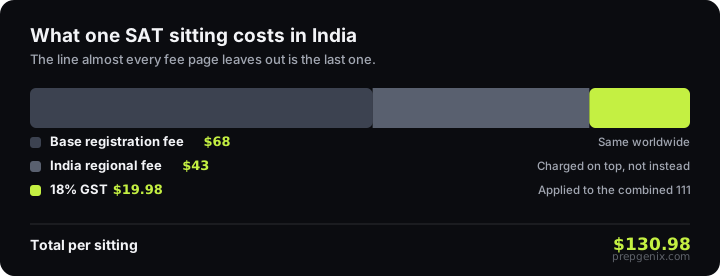
The full fee table
| Item | Cost (USD) | Roughly (INR) | Note |
|---|---|---|---|
| Base registration | $68 | ₹6,500 | Same worldwide |
| India regional fee | $43 | ₹4,100 | Added, not substituted |
| 18% GST | $19.98 | ₹1,900 | Charged on the combined $111 |
| Total per sitting | $130.98 | ₹12,548 | Before any extras |
| Late registration | +$38 | +₹3,610 | If a seat still exists |
| Change of center or date | +$34 | +₹3,230 | Per change |
| Extra score report | $13–15 | ₹1,250–1,430 | After the four free ones |
Rupee figures move with the exchange rate; treat them as approximate and the dollar figures as the real ones, since that is what gets charged.
The India Scholars Program, which very few people use
College Board runs a fee-discount scheme specifically for students in India, and it is substantially more generous than the standard international position, where, notably, US fee waivers do not cover the international fee at all. For how international administrations differ from United States ones more broadly, see international SAT versus the US SAT.
| Annual family income | Discount | Approximate cost per sitting |
|---|---|---|
| Below ₹8 lakh | 90% | about ₹1,245 |
| ₹8 lakh to ₹15 lakh | 50% | about ₹6,270 |
It is open to Class XI and XII students living in India, and it works as a discount voucher applied at registration rather than as a reimbursement. Apply before you book, not after, and apply early, because the voucher has to be in hand when you register and center availability will not wait for it.
Income thresholds and discount tiers are set by College Board and have moved before. Confirm the current bands on College Board's own India pages before planning around them; the figures above reflect the 2026 program as published.
Dates: the same eight as everywhere else
India follows the international calendar with no separate schedule. For 2026–27 that is 22 August, 12 September, 3 October, 7 November and 5 December 2026, then 6 March, 1 May and 5 June 2027.
Score release runs on the same 13-day cycle as everywhere else, so an August 22 sitting returns scores on 4 September regardless of where you sat it. The score calculator converts a practice raw count into a scaled estimate.
Seats are the real constraint, not the fee
Third-party trackers count roughly 98 authorized test centers across India; College Board does not publish a running total, so treat that as a good estimate rather than a fixed figure. The distribution is what matters. Delhi, Mumbai, Bangalore, Chennai and Hyderabad have somewhere between five and twelve centers each. A tier-2 city frequently has one or two, total.
In the August-to-December peak, metro centers commonly close three to four weeks before the date and tier-2 centers go earlier. So the practical registration deadline is not the official one.
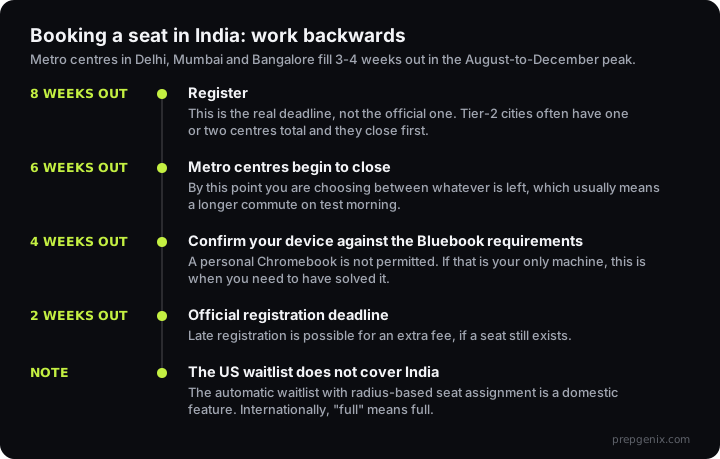
The safety net that does not reach you
For the Fall 2026 administrations College Board introduced a domestic waitlist that automatically assigns a seat within a radius you choose, alongside dynamic capacity that releases seats in real time as demand appears. It is a good change and it substantially reduces the "everything near me is full" problem.
It is a United States feature. Internationally, including in India, "full" means full. There is no automatic waitlist to join and no radius-based reassignment, which is why the advice that circulates on Reddit, "just join the waitlist and re-check", is advice for a different country. Book early instead; it is the only mechanism available to you.
Devices: the rule that catches Indian students hardest
As of the Fall 2026 administrations, personal Chromebooks are prohibited. Only school-managed Chromebooks with Verified Mode enabled through the school's admin console are permitted, and most Indian schools have never configured it because they have never needed to.
Otherwise the floors are ChromeOS 132+, macOS 12+, iPadOS 16+, and Windows 10 permitted with 11 recommended, and Windows 10 is on borrowed time now that Microsoft has ended support. Smart glasses are prohibited outright.
Test centers can lend devices, but the request has a lead time measured in weeks, not days. If a personal Chromebook is the only computer in the house, that is a problem to solve a month out. The full rules are in our device requirements guide.
Does the SAT still matter for Indian applicants?
More than it did three years ago. Six of the eight Ivy League universities require scores for 2026–27 entry, with Princeton and Columbia returning for 2027–28, and MIT, Stanford, Caltech and Georgetown all require them. For international applicants specifically the score carries extra weight, because admissions officers reading a CBSE, ICSE or state-board transcript have far less context for it than for a US high school GPA. A standardized number is the one directly comparable data point in the file.
It also carries money. Merit aid at US public universities is frequently score-gated, and for a family paying international fees that is the difference between an offer that is affordable and one that is not.
Frequently asked questions
How much does the SAT cost in India in 2026?
$130.98, roughly ₹12,548. That is $68 base registration plus a $43 India regional fee, with 18% GST applied to the combined $111. Indian centers do not charge the separate $24 center fee that applies in some other regions.
Is there a fee waiver for the SAT in India?
Yes, through College Board's India Scholars Program. Class XI and XII students living in India with annual family income below ₹8 lakh can get a 90% discount voucher, bringing a sitting to about ₹1,245. Families between ₹8 lakh and ₹15 lakh qualify for 50% off. Apply before registering, not after.
How many SAT test centers are there in India?
Third-party trackers count around 98 authorized centers, though College Board does not publish a running total. The distribution matters more than the count: metros like Delhi, Mumbai and Bangalore have five to twelve each, while tier-2 cities often have one or two.
When should I register for the SAT in India?
About eight weeks before your date. Metro centers commonly close three to four weeks out during the August-to-December peak and tier-2 centers go earlier, so the official two-week deadline is not the real one.
Can I join a waitlist if SAT centers in India are full?
No. The automatic waitlist with radius-based seat assignment that College Board introduced for Fall 2026 is a United States feature. Internationally, including India, a full center is simply full, which is why booking early is the only mechanism available.
Are the SAT dates in India different from the US?
The international calendar has eight dates for 2026–27: 22 August, 12 September, 3 October, 7 November and 5 December 2026, then 6 March, 1 May and 5 June 2027. India follows it with no separate schedule, and score release runs on the same 13-day cycle.
Can I use my Chromebook for the SAT in India?
Only if it is a school-managed device with Verified Mode enabled through the school's admin console. Personal Chromebooks are prohibited as of the Fall 2026 administrations, and most Indian schools have never configured Verified Mode. Sort this out a month before the test, since loaner requests take weeks.
Do US colleges require the SAT from Indian students?
Many do. Six of the eight Ivies require scores for 2026–27 entry, with Princeton and Columbia returning for 2027–28, and MIT, Stanford, Caltech and Georgetown require them. The score also carries extra weight for international applicants because admissions officers have less context for a CBSE, ICSE or state-board transcript.