A Bluebook practice score is the best free predictor of a real SAT score that exists: real retired questions, the real adaptive engine, the real interface, and College Board's own conversion table for that form. It is also not a promise. It drifts in four directions that are known and mostly fixable, and three of the four inflate rather than deflate. If your real score came back below your Bluebook average, the explanation is usually on this page.
This is about what a practice number means. If you are choosing which form to sit and in what order, that is a different question and we cover it in the ranked guide to all eight tests. The official practice tests are distributed through College Board's practice test page.
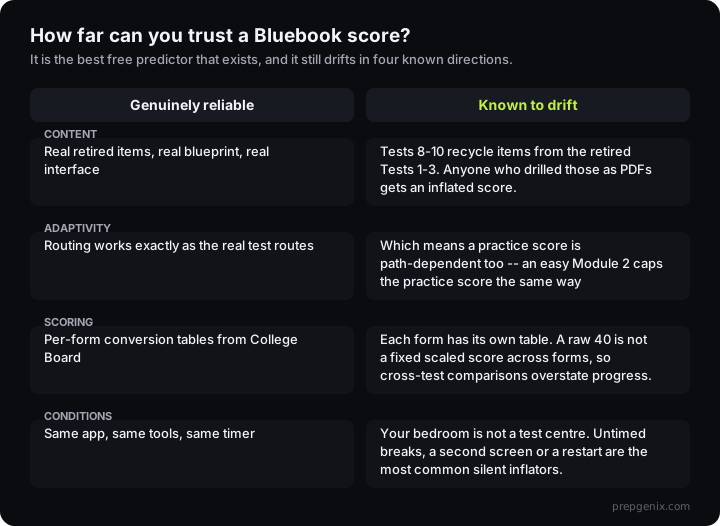
Drift 1: three of the eight forms are contaminated for some students
Bluebook currently offers eight SAT forms, numbered 4 to 11. Tests 1, 2 and 3 were retired on 3 February 2025. But retired does not mean destroyed, Tests 8, 9 and 10 recycle items from them.
For a student who never saw the originals, that is irrelevant. For anyone who drilled Tests 1–3 as circulating PDFs, which was extremely common in 2024, it means Tests 8–10 are partly a memory exercise. The score comes back high, the student believes it, and the real administration corrects the record two weeks later.
College Board sometimes describes "twelve practice tests" in Bluebook. That count includes the PSAT-suite forms. For the SAT specifically you have eight, and that is a budget for your whole preparation rather than a supply. To compare a practice result against a target, convert it with the raw-to-scaled calculator.
Drift 2: cross-test comparisons overstate progress
This is the one that misleads the most students. Each Bluebook form carries its own raw-to-scaled conversion table, because each form is a slightly different difficulty and equating exists to compensate.
So a raw score of 40 on Test 5 and a raw score of 40 on Test 9 are not the same scaled score, and a 60-point "gain" between two forms taken a month apart may be entirely a property of the two forms. Genuine improvement shows up as a trend across three or more tests, not as a jump between two.
The honest way to read it: treat any single practice score as a range of roughly ±30 points, not a point. If you scored 1380, what you know is that you are somewhere around the low-to-mid 1300s to low 1400s on that day.
Drift 3: your bedroom is not a test center
The most common inflators are all conditions rather than content:
- An untimed or extended break. The real break is ten minutes and it does not stretch.
- Pausing, restarting, or splitting the test across two sessions. The real thing is 2 hours 14 minutes continuous, and the fatigue in the second half of Math is a real component of the score.
- A phone within reach, a second screen, or someone in the room.
- Starting at 8 p.m. when the real test starts at 8 a.m. Not trivial. Most students are measurably sharper in the evening and then sit the real test at their worst hour.
Each of these is worth a handful of points on its own. Together they routinely account for the entire gap between a practice average and a real score.
Drift 4: practice scores are path-dependent too
Bluebook adapts exactly as the real test does, which is a strength, and it means a practice score inherits the same structural quirk. Your Module 1 performance routes you into a harder or easier Module 2, and the easier path carries a scaled ceiling around 650 in Reading & Writing and 670 in Math on our model of the curve.
So a practice score of 1290 can mean two completely different things. It can mean you routed hard and performed at 1290. Or it can mean you routed easy, worked the second module almost perfectly, and hit the ceiling, in which case the number understates you, and the fix is entirely in Module 1. Same score, opposite diagnosis, and Bluebook does not tell you which one happened in plain language.
We wrote about the mechanism in detail in what an easy Module 2 means.
Which form to trust most
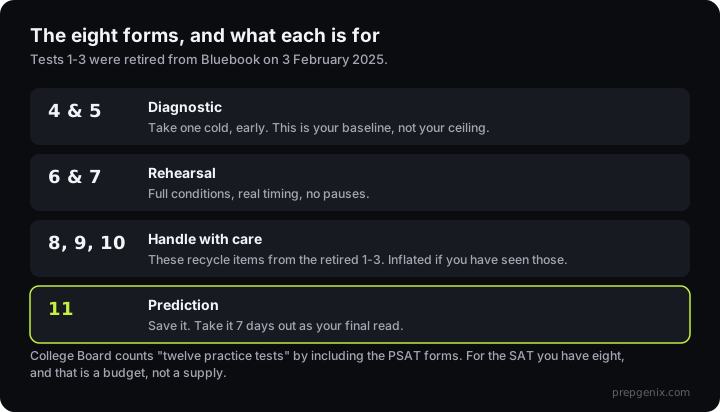
If you want the single most predictive read available to you, it is Test 11, taken cold, in the morning, under full conditions, two to three weeks before your administration. It is the newest form, so it is closest to what College Board is currently writing. Two to three weeks out is late enough that the score reflects the preparation you did, and early enough to act on what it shows.
Does the Bluebook practice SAT give you a real score?
Nobody can give you a validated number, and anyone quoting one is quoting their own students. College Board publishes no study on Bluebook's predictive accuracy against real administrations, and third-party claims of "within 30 points" are marketing rather than research.
What can be said with confidence is structural. Bluebook uses real items, the real engine and official per-form conversion tables, which puts it categorically ahead of any third-party practice test. Its errors are dominated by conditions and form selection, both of which are under your control. Control those and a Bluebook average across three recent forms is a good estimate. Ignore them and it is an optimistic one. If your real score has just come in lower than your Bluebook average, what to do in the fortnight after release is the more useful question.
How to read your Bluebook practice test scores
| What you see | What it probably means | What to do |
|---|---|---|
| One test far above the others | Form effect, or a contaminated form (8–10) | Discard it. Trust the median of your last three. |
| Scores flat across four tests | Not a plateau in ability, usually a plateau in method | Stop taking tests. Review the last one properly instead. |
| Real score below practice average | Conditions, most likely, then form effect | Rebuild practice conditions before concluding anything about ability. |
| Section score capped near 650 or 670 | You routed into the easier Module 2 | The fix is in Module 1, not in Module 2 accuracy. |
| Real score above practice average | Genuine, and more common than students expect | Test-day adrenaline is real. Do not talk yourself out of it. |
Frequently asked questions
Are Bluebook practice tests accurate?
They are the most accurate free predictor available, because they use real retired questions, the real adaptive engine and College Board's own per-form conversion tables. Full answer
Why was my real SAT score lower than my Bluebook score?
Most often conditions rather than ability: an extended break, a paused or split session, an evening start against an 8 a.m. real test. The second most common cause is taking Tests 8, 9 or 10 after having drilled the retired Tests 1 to 3, since those forms recycle items from them.
Which Bluebook tests are the most accurate?
Test 11 is the newest and closest to what College Board is currently writing, so it is the best single predictor when taken cold two to three weeks out. Tests 4 to 7 are reliable for most students. Tests 8, 9 and 10 recycle items from the retired Tests 1 to 3 and will read as inflated for anyone who saw those.
How much can a Bluebook score differ from a real SAT score?
There is no published validation study, and any specific figure you see is someone's own student data rather than research. Treat a single practice score as a range of roughly plus or minus 30 points, and trust the median of your three most recent forms over any one of them.
Can I compare raw scores between Bluebook tests?
No. Each form carries its own raw-to-scaled conversion table because each form differs slightly in difficulty. Full answer
Why did my Bluebook score cap out around 650?
You almost certainly routed into the easier Module 2. That path carries a scaled ceiling near 650 in Reading and Writing and 670 in Math, so the second module cannot lift you past it no matter how cleanly you work it. The fix belongs in Module 1.
How many Bluebook practice tests should I take?
Three to five across a full preparation cycle. There are only eight SAT forms and they do not regenerate, so they are a budget rather than a supply. Use the Question Bank for volume and save the forms for measurement.
Does Bluebook adapt the same way as the real SAT?
Yes. The routing works identically, Module 1 performance decides whether Module 2 is the harder or easier version, and the same scaled ceiling applies to the easier path. This is the main reason Bluebook beats third-party practice tests, most of which do not model routing at all.