The Student Question Bank is several thousand real, released SAT questions, free on College Board's own site, and filterable by assessment, section, domain, skill and difficulty. It is the best free practice material in existence and the most badly used. The difficulty filter is the reason. Most students drill an unfiltered mix, get an inconsistent-looking result, and conclude they are inconsistent, when what they did was take a random sample.
This is a guide to using it deliberately. It is a companion to our wider ranking of free SAT resources, which covers where the Question Bank sits among everything else; this page is only about getting the most out of that one tool. We also measured our own bank against the official blueprint and published where it drifts.
What the Bluebook Student Question Bank is, and what it is not
The Question Bank is a searchable archive. It is not a course, not a test, and not adaptive. You pick filters, it returns questions, you work them, and you check the answer and explanation. There is no timer and no score.
That sounds like a limitation and mostly it is a feature. Bluebook gives you a score but no control; the Question Bank gives you control but no score. You need both, at different moments, for different reasons.
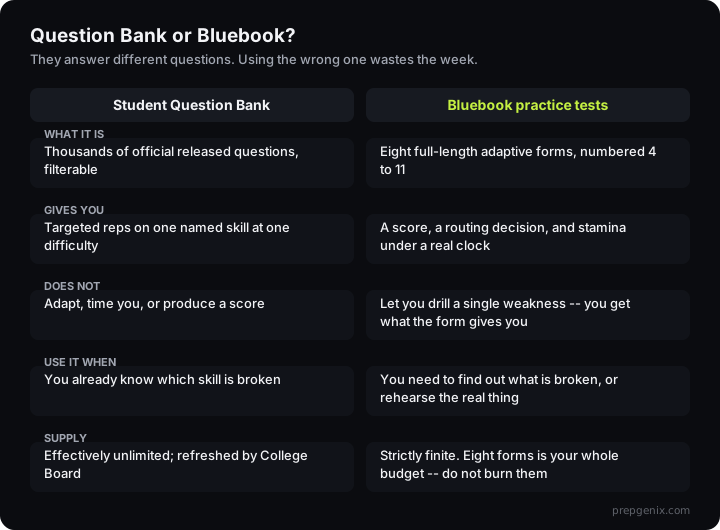
Note the last row especially. You get eight full-length SAT forms in Bluebook, numbered 4 to 11 since Tests 1–3 were retired on 3 February 2025. That is a fixed budget for the whole of your preparation. The Question Bank, by contrast, is effectively unlimited and College Board keeps adding to it, which means every hour of drilling you move out of Bluebook and into the Question Bank is an hour that preserves a scarce resource.
What changed in August 2026
College Board pushed an update to the Question Bank in August 2026. An analysis by Sigma Prep, which diffed a March 2026 snapshot against the August version and filtered out reshuffles and duplicates, put the change at 196 new Math questions.
Two things follow from that, and the second matters more than the first. New items reflect the style College Board is writing now, which drifts over time. And almost nobody has worked them, so they give a cleaner read on readiness than material that has been circulating in every prep deck for two years. If you have been preparing since spring, the bank you remember is not the bank that is there today.
College Board does not publish the total number of questions in the bank, and third-party counts range from about 3,000 to over 5,000 depending on whether PSAT items and retired forms are included. Anyone quoting a precise figure is quoting their own scrape. What is not in dispute is that it is far more than you will ever work through.
Three filter recipes
Set Assessment to SAT and Test to Reading and Writing or Math. The next three filters (domain, skill, difficulty) are where the value is, and the right combination depends entirely on where you currently score.
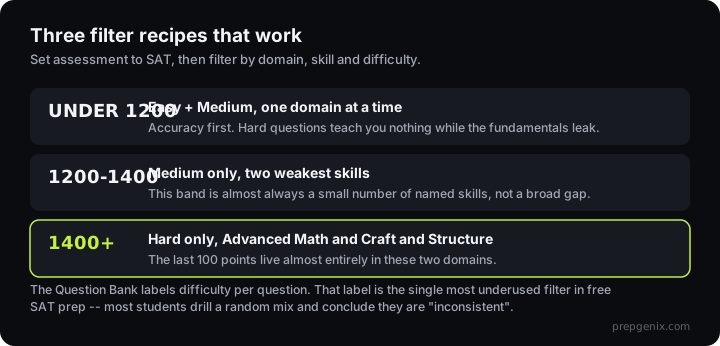
The logic behind the split is that hard questions only teach you something once the fundamentals underneath them are solid. Below about 1200 a Hard-filtered set mostly produces a long run of wrong answers, which teaches you that you are bad at the SAT rather than which specific thing is broken. Above 1400 the reverse is true: Easy and Medium questions confirm what you already know and cost you the hour.
How to use the SAT Question Bank: one session
A session is one skill, one difficulty, ten to fifteen questions, no timer.
- Pick one skill. Not a domain, a skill. "Advanced Math" is four weeks of work; "Nonlinear equations in one variable" is a session.
- Work all of them before checking any answers. Checking as you go lets the previous explanation contaminate the next attempt, and you lose the ability to see a pattern across the set.
- Mark each miss as content or process before reading the explanation. Could you get it with another two minutes and no help? Then it was process. Could you not? Then it was content. The fixes are completely different.
- Read the explanations for the ones you got right but guessed. These are the invisible losses. A lucky guess at 1300 becomes a wrong answer at 1450 when the same skill reappears one difficulty level up.
- Re-run the same filter a week later. If accuracy has not moved, the problem was not reps.
Where to aim: the blueprint
Not all domains are worth the same amount of your time, because they are not equally represented on the form. Math skews hard toward two of its four domains:
| Math domain | Share of the section | Roughly, of 44 questions |
|---|---|---|
| Algebra | ~35% | 14–17 |
| Advanced Math | ~35% | 14–17 |
| Problem-Solving and Data Analysis | ~15% | 6–8 |
| Geometry and Trigonometry | ~15% | 6–8 |
Algebra and Advanced Math are about 70% of the Math section between them. A week spent on Geometry and Trigonometry is a week spent on six or seven questions. That is sometimes the right call (if those six are all wrong, it is a lot of points sitting in one place) but it should be a decision, not a default.
Reading & Writing is flatter, and the largest domain is the one students least expect: Craft and Structure at roughly 28%, ahead of Information and Ideas at 26%, Standard English Conventions at 26% and Expression of Ideas at 20%. Vocabulary in context lives in the largest domain on the section.
The three things it cannot do
Being clear about the limits is what stops the Question Bank from becoming your whole plan:
- It cannot score you. There is no raw-to-scaled conversion and no percentile. Accuracy on a filtered set is not a score and does not translate into one, because the real test is adaptive and a filtered set is not.
- It cannot route you. The single most consequential mechanic on the digital SAT, Module 1 deciding whether Module 2 is the hard or easy version, is entirely absent. You can be excellent at filtered Medium questions and still route low.
- It cannot build stamina or pacing. Untimed sets of fifteen do not rehearse 98 questions across two hours and fourteen minutes.
Which is why the honest plan is not "Question Bank instead of tests". It is tests to find out what is wrong, the Question Bank to fix it, and tests again to check whether the fix held.
Frequently asked questions
Is the SAT Question Bank free?
Yes. The Student Question Bank is free on College Board's own site at satsuite.collegeboard.org/practice/student-question-bank and requires no paid account. The questions are real released SAT items written by the same people who write the test.
How many questions are in the SAT Question Bank?
College Board does not publish a total. Third-party counts range from roughly 3,000 to over 5,000 depending on whether PSAT items are included. The practical answer is that it is far more than any student will work through, so the limiting factor is filtering, not supply.
What is the difference between the Question Bank and Bluebook?
Bluebook gives you eight full-length adaptive practice tests that produce a score, a routing decision and stamina practice. The Question Bank gives you unlimited filtered questions on one named skill at one difficulty, with no timer and no score. Use tests to find out what is broken and the Question Bank to fix it.
Did College Board add new questions to the Question Bank in 2026?
Yes. An August 2026 update added roughly 196 new Math questions, according to an analysis by Sigma Prep that compared a March 2026 snapshot against the August version and filtered out duplicates and reshuffles. New items reflect the style College Board is writing now and have been seen by far fewer students.
Can the SAT Question Bank tell me my score?
No. There is no raw-to-scaled conversion and no percentile, and accuracy on a filtered set does not translate into a score because the real test is adaptive and a filtered set is not. For a score you need a full adaptive form.
Which difficulty should I filter to?
Below about 1200, Easy and Medium in one domain at a time. Between 1200 and 1400, Medium on your two weakest skills. Above 1400, Hard only, concentrated in Advanced Math and Craft and Structure. Filtering to Hard too early produces a long run of wrong answers that teaches you nothing specific.
Is the Educator Question Bank different from the student one?
Yes. The Educator Question Bank is a separate tool intended for teachers and requires an educator account. It exposes some additional metadata and assembly features, but the underlying questions overlap heavily with the student version, which is the one to use if you are preparing on your own.
How many Question Bank questions should I do per session?
Ten to fifteen on a single skill at a single difficulty, worked all the way through before you check any answers. Checking as you go lets one explanation contaminate the next attempt and hides the pattern across the set.