Here is a structural fact almost nobody acts on: both SAT sections are scored 200–800, but Math spreads that 600-point range over fewer questions. About 40 Math items count against about 50 in Reading & Writing. So one Math question is worth roughly 15 scaled points and one R&W question about 12, a ratio of about 1.25 to 1. All else equal, an hour that fixes a Math question buys more than an hour that fixes an R&W one.
All else is not always equal, which is what the rest of this is about. But the arithmetic is the starting point and it is not in dispute.
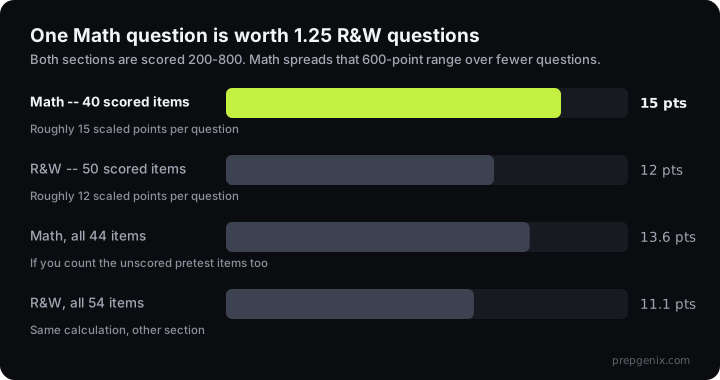
Each form carries unscored pretest items, roughly 4 of the 54 Reading & Writing questions and 4 of the 44 Math questions do not count toward your score, and you cannot tell which. Divide 600 points by the ~50 and ~40 that do count and you get 12.0 and 15.0. Divide by all 54 and 44 and you get 11.1 and 13.6. The ratio survives either way, which is what makes it trustworthy.
| Section | Questions on the form | Scored (operational) | Scaled range | Points per scored question |
|---|---|---|---|---|
| Reading & Writing | 54 | about 50 | 200–800 | ~12.0 |
| Math | 44 | about 40 | 200–800 | ~15.0 |
Three reasons Math is usually the faster fix
The content is finite. SAT Math is a closed list: linear equations, systems, quadratics, exponentials, ratios, a small amount of geometry and right-triangle trigonometry. You can write it on two pages and work through it. Reading & Writing has no equivalent list, because the skill is comprehension applied to passages you have never seen.
The feedback is unambiguous. A wrong Math answer has a locatable cause: you did not know the method, or you made a specific slip. A wrong inference question often comes down to "I picked the second-best choice", which is much harder to convert into a study action.
Two domains carry 70% of it. Algebra and Advanced Math are roughly 35% each. Fixing Algebra is not fixing a quarter of a section, it is fixing about fifteen questions. Reading & Writing is flatter (28%, 26%, 26%, 20%) so there is no equivalent concentration to attack. Both section blueprints are set out in College Board's test structure.
And two reasons it is sometimes wrong
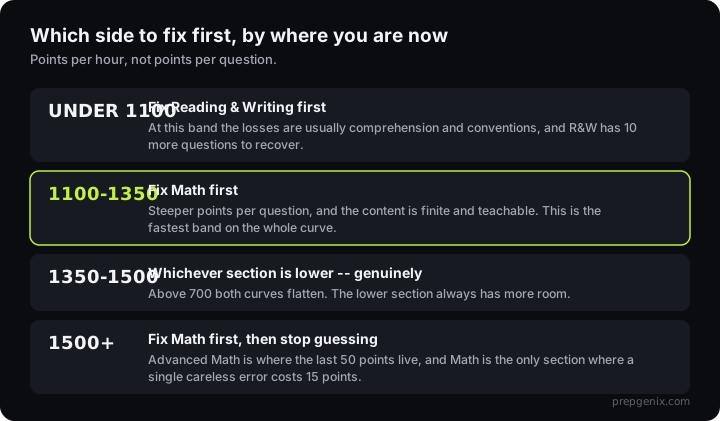
Reading & Writing is 54 of the 98 questions. More questions means more room, and at low bands that room matters more than the per-question rate. A student at 480 in R&W has far more recoverable points available than the multiplier suggests.
R&W transfers and Math does not. Reading closely and handling dense prose under time pressure is a skill that pays in every other class and in the application essay. Nonlinear systems are not. If the two are close, that is a legitimate tiebreaker.
The rule, by where you are now
The overriding rule: fix the lower section
Everything above is a tiebreaker. If one section is 80 or more points below the other, that is where the hours go, and no per-question multiplier changes it.
The reason is the shape of the curve. Both sections get steeply harder to improve as you approach 800. The last 50 points in a section cost several times what the middle 50 cost. So a student at 700 Math and 560 R&W has cheap points sitting in R&W and expensive ones in Math, and the multiplier is nowhere near large enough to overcome that. Balanced sections are also easier to defend in an application than a lopsided pair.
Working out your own answer
Three numbers, and you can have them in an afternoon:
- Your two section scores from a full adaptive form, not from a filtered practice set.
- Which routing path you landed on in each section. A section capped near 650 or 670 is not measuring your ability. It is measuring your Module 1, and the fix belongs there regardless of which section it is.
- The domain breakdown underneath each score. A 620 Math built from even performance across four domains is a different problem from a 620 built on a collapse in Advanced Math, and only the second one has a fast fix.
Then apply the order: lower section first if the gap is wide; Math first if they are close; and if either section routed easy, Module 1 before anything else.
Frequently asked questions
Is SAT Math or Reading and Writing worth more points?
Per question, Math. Both sections are scored 200 to 800, but roughly 40 Math questions count toward your score against roughly 50 in Reading and Writing, so a Math question is worth about 15 scaled points and an R&W question about 12, a ratio of about 1.25 to 1.
Which SAT section is easier to improve?
Math, for most students in the 1100 to 1350 band. The content is a finite list you can work through, the feedback on a wrong answer is unambiguous, and two domains carry about 70% of the section. Reading and Writing has no equivalent concentration to attack.
Should I focus on my weaker SAT section?
Yes, if the gap is 80 points or more. Both sections get steeply harder to improve near 800, so a student at 700 Math and 560 Reading and Writing has cheap points in R&W and expensive ones in Math. The per-question multiplier is not large enough to overcome that.
How many SAT questions count toward my score?
Roughly 50 of the 54 Reading and Writing questions and roughly 40 of the 44 Math questions. The rest are unscored pretest items being trialed for future forms, and you cannot tell which ones they are, so every question has to be answered as though it counts.
Which SAT Math domains should I prioritize?
Algebra and Advanced Math, which are roughly 35% each and about 70% of the section between them. Problem-Solving and Data Analysis and Geometry and Trigonometry are about 15% each, or six to eight questions apiece.
My Math score is capped around 670. Why?
That is the ceiling of the easier Module 2 on our model of the curve. It means Module 1 routed you into the lower adaptive path, so the score is measuring your Module 1 rather than your overall Math ability. The fix belongs in Module 1, not in Module 2 accuracy.
Can I improve both SAT sections at once?
You can maintain both, but splitting focused study time evenly is usually slower than sequencing it. Four weeks concentrated on one section then four on the other generally produces more total improvement than eight weeks of alternating.
Does a balanced SAT score matter to colleges?
Mildly. Most admissions offices read the total and the section scores, and a large imbalance invites a question a balanced pair does not. It is a secondary consideration behind the total, but it is another reason to fix the lower section first.